 PRODRAFTSTATS™PRODRAFTSTATS™
Monday’s bench total mixes a mistake you could have caught with a result nobody could.
Your Monday bench total holds two kinds of points. One you could catch before kickoff: a player our number would start, sitting on your bench at lock. The other is hindsight, points only final scores reveal. The desk splits them, and an amber notice flags the first before lock. The call stays yours.
Your bench total on Monday is lying to you. It treats every point your benched receiver scored as the same kind of mistake, and it isn’t. Part of it is a call you could have checked before kickoff: was a player our number would start sitting on your bench at lock? The rest is hindsight, points that only the final scores could reveal. Your brother-in-law in the league chat will not make that distinction, but you can. We split the number in two, so you can see how much of your regret was catchable and how much was just the game being played. If our number would have started someone you benched, you get an amber notice before lock, and the decision stays yours. Below: how the check works as kickoff nears, and where it can’t help.
The first number is a fact you can check before a snap is played: is a player our number would start sitting on your bench at lock? We build a lineup from the best number on record, then compare it with the lineup actually set on ESPN, slot by slot. He is either sitting or he is not, so this is a number a check can find before kickoff. We have no record yet of it being driven down, and late scratches are a residual no check can catch.
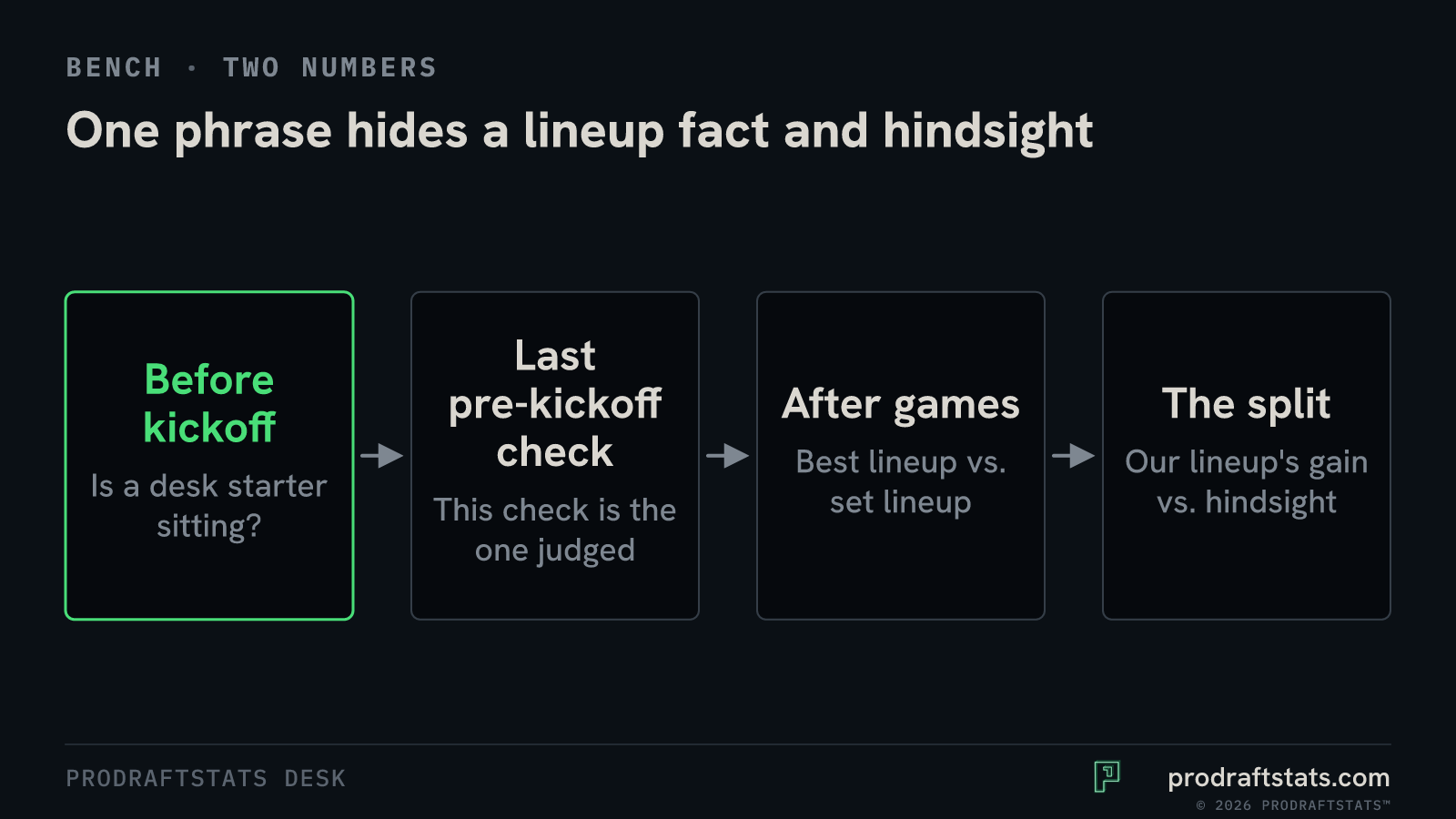
But the second number is not like that. After the games, we take the best legal lineup by actual points and subtract your set lineup’s actual points. Nobody zeroes that without knowing the future. We report it anyway, and we split it in two: the part our own number’s lineup would have gained, and the part only the final scores could show. Neither half is a clean measure of decision quality.
That is why the check is built around the clock. Far from kickoff nothing is urgent, so the lineup is checked now and then. As lock gets closer, it is checked more and more often, most often in the last ninety minutes before a desk starter’s kickoff.
Why ninety minutes? Inactives publish about 90 minutes before kickoff, so that window is where a late scratch can still reach you as a notice, as long as it comes before the game locks.
When a recommended starter is sitting, the amber notice shows above whatever screen you are on. It gives his name, our number, the player in his place, the coming lock and the swap our number points to. That is a projection, not a verdict on who wins your matchup, and the decision is yours. It clears on the first check that finds nobody sitting.
Because the notice is only half the story, the split matters. Fans grade decisions by results. You bench a receiver, he scores, and by Monday you are sure you blew it. That is outcome bias: judging a choice by how it turned out instead of by what you could know when you made it.
Lump everything into one bench number and every point of regret looks like the same kind of mistake. Splitting it answers a narrower question: how much of this week’s hindsight bench would our own number’s lineup have gained, and how much could only the results show? Be careful with the first part. It is still graded by actual points, so it is a guide, not a verdict on whether the decision was sound. One week’s gap in the recommended lineup’s favour is not evidence the number has an edge.
Late scratches are the hardest case. A player ruled out at 80 minutes reaches you as a notice. If you opted in to automatic swaps, the desk requests the change for you instead (see the limits below). But a player ruled out after his game locks is nobody’s decision, and his points land in the hindsight half.
The automatic swap has not yet been proven against ESPN. Until it is, turning it on is a request, not a guarantee, and the notice says so. A scratch that comes after lock is beyond any check. We also have no 2026 results to show here, so nothing on this page says a recommendation was right or wrong.
Send this to the league chat member who grades every bench decision by Monday’s scores.
Source: ProDraftStats desk.
It mixes two things. One is whether a player our number would start sat on your bench at lock, which you can check before kickoff. The other is a hindsight number: the best legal lineup by actual points minus your set lineup's actual points. The desk splits that hindsight number into the part our number's lineup would have gained and the part only final scores could show. Neither half is a clean measure of decision quality.
Inactives publish about 90 minutes before kickoff. That window is where a late scratch can still reach you as a notice, as long as it comes before the game locks.
Not unless you turn on AUTOPILOT, which is off by default. It never adds, drops or trades players, and it never moves a player to or from injured reserve. The automatic swap has not yet been proven against ESPN, so turning it on is a request, not a guarantee.
ProDraftStats launches in 2027. Join the free waitlist.