 PRODRAFTSTATS™PRODRAFTSTATS™
The cheat sheet starts going stale with pick one. Why that happens, and what a live board does about it.
A printed cheat sheet goes stale with the first pick. Draft a running back and the fallback line drops a spot, so every back left sits further above replacement. A live board re-prices after each pick, in about 30 ms as reported. We have not measured how large that shift is.
Send this to the guy in your league chat who prints the cheat sheet every August and brings it to the draft in a folder. If you’ve seen him, you know he means well. But the minute the first running back is taken, his sheet stops describing the draft you are in. Every back still available now sits further above the fallback behind him, which just dropped a spot, and a printed number can’t show that. How much further depends on your league’s slots and how deep the pool is, and we have not measured it. Our live draft board redoes the math after every pick, about 30 milliseconds each time, against a 45 to 90 second clock, after a one-time load of about 2.9 seconds. It won’t tell you who to take, and we say so plainly. Read on for what it does, and the one number we still can’t give you.
The math has to keep up with a 45 to 90 second clock, so we timed it. Loading everything the board needs takes 2852 ms, paid once, when the draft opens. After that, re-pricing the board for a new pick takes 30 ms. Typing a player’s name and re-pricing takes 44 to 67 ms. These are single reported timings, not a spread across many runs.
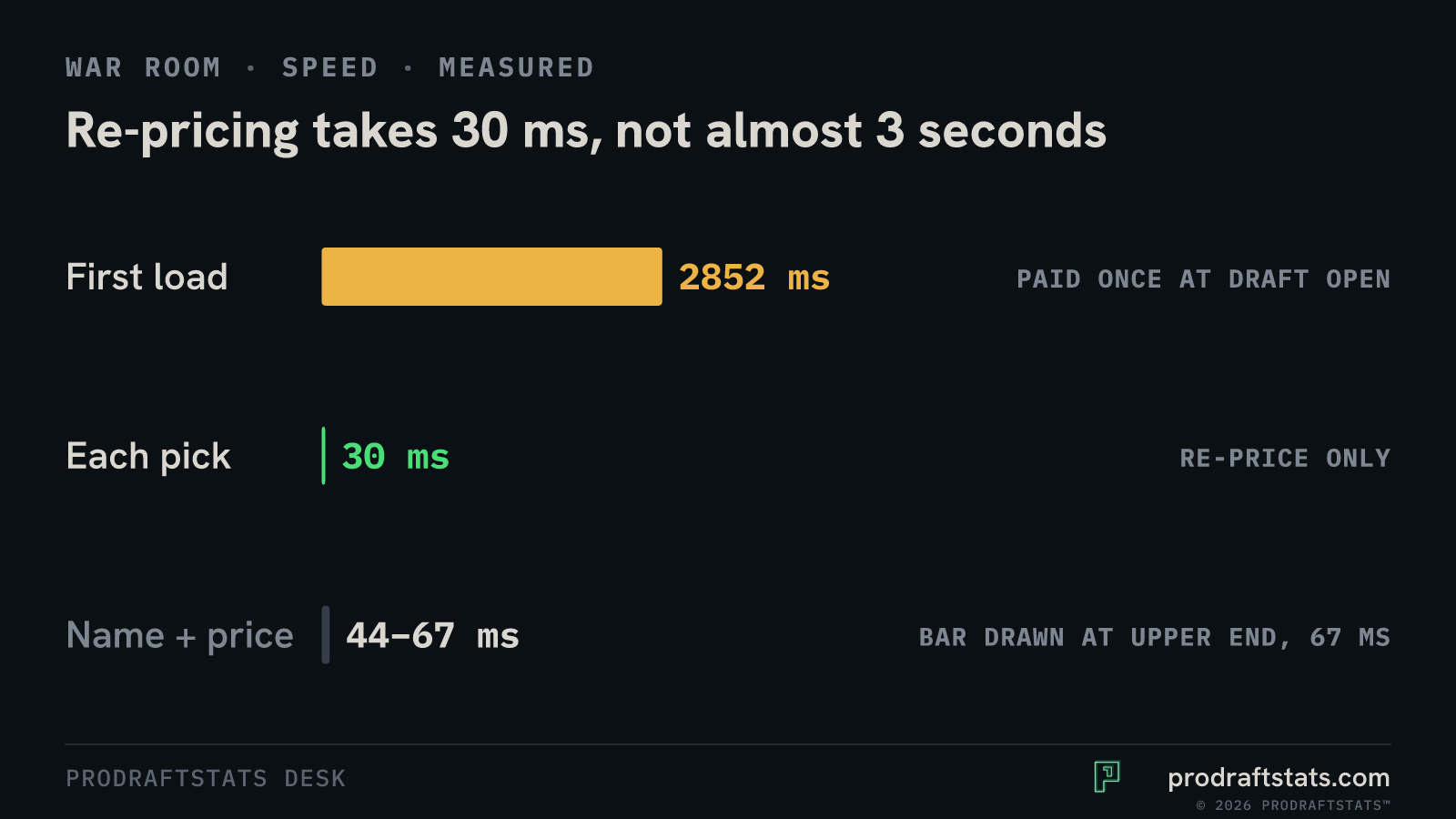
Each pick is about 95 times cheaper than a full reload on those timings (2852 ÷ 30), and 30 ms is about 1500 times shorter than a 45-second clock. Using the slower 67 ms figure, the headroom is about 670 times.
That is why speed is not the interesting problem. A board that doesn’t know a player has been taken describes a fixed pool, and in a real draft the pool changes twenty times an hour. The harder question is what a pick should do to the numbers once the board knows about it.
Crossing a name off is the easy part. The property that matters is that removing a player moves the fallback line. The fallback is the first back past the last starting slot. When a back is taken, that line slides one place down the list, so the back standing at it is a weaker one.
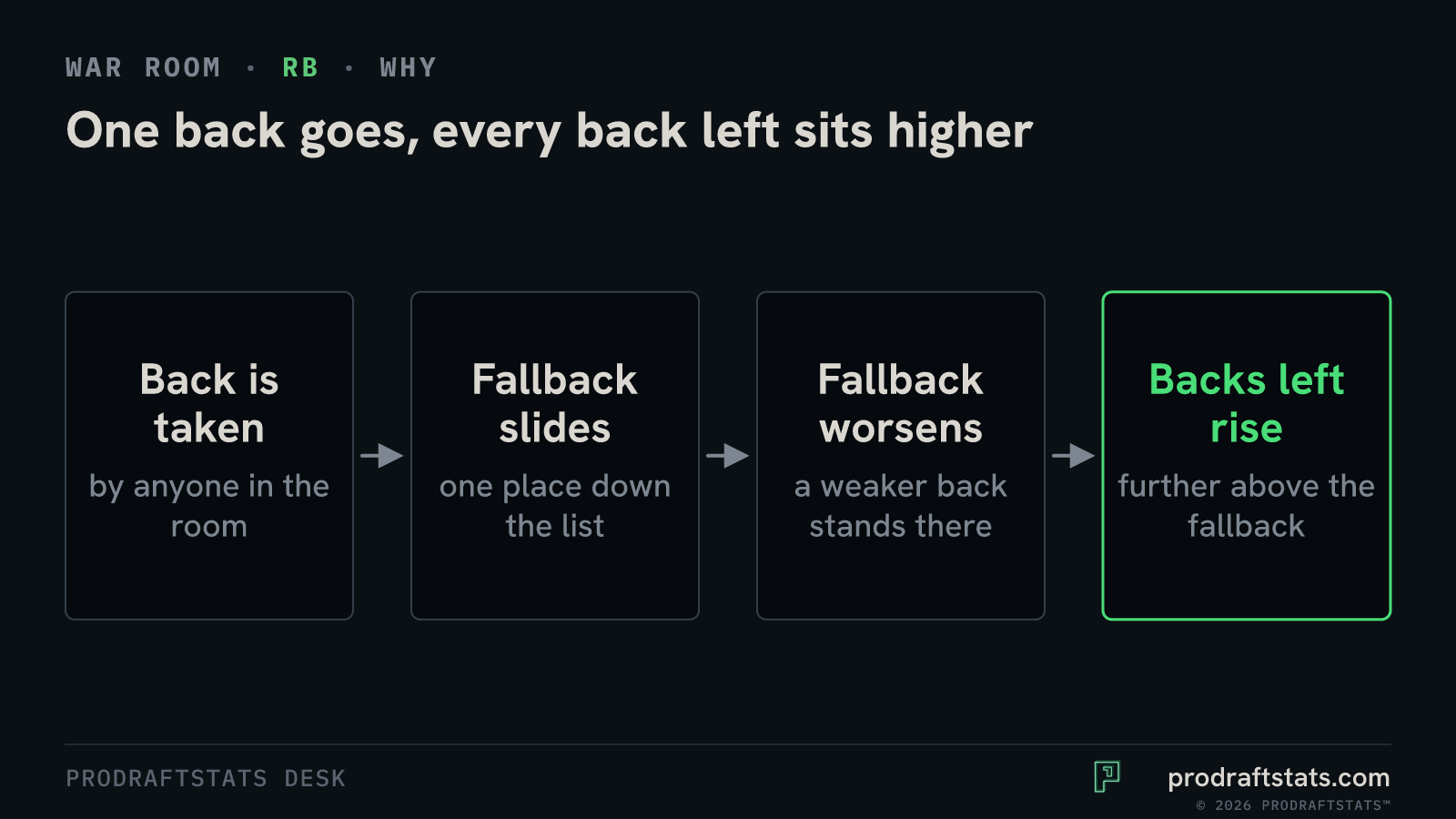
Because of that, every back still available sits further above the fallback. A board that filtered its display but not its arithmetic would miss this entirely.
Here is the catch: we have not measured how large that shift is in a typical draft. The size depends on your league’s starting slots and on how deep the pool is. A higher value over replacement for backs is one input. It does not say you should take a back at your pick. Other positions move too, and the board does not tell you which pick to make.
What a rational drafter gets wrong is anchoring. The board you printed before the draft becomes the reference point for the whole night. But every pick moves the line those numbers were measured against. With no picks recorded, the live board and the pre-draft board are identical. Once the draft starts, only one of them is telling the truth.
Names are where boards quietly break, so that is where we are strict. A plain lookup misses “Ja’Marr Chase” typed with a curly apostrophe, and misses “Kenneth Walker III” against “Kenneth Walker”. When two candidates tie outright, the board refuses to guess and shows you both as a clickable list, because marking the wrong player gone is worse than marking nobody.
None of this is a recommendation. A best-available screen is instrumentation, and a “take this player” call would be an unvalidated signal with no archive of drafts yet to test it against. So the panel says what it is: a screen, not a validated edge. The ADP columns stay empty until drafts are banked.
Send this to whoever in your league chat prints the cheat sheet.
Source: ProDraftStats desk.
When a running back is taken, the fallback line slides one place down, so every back left sits further above replacement. A printed number can't show that. The size of the shift depends on league slots and pool depth, and we haven't measured it.
After a one-time load of about 2.9 seconds (2852 ms), re-pricing takes 30 ms. Typing a player's name and re-pricing takes 44 to 67 ms, against a 45 to 90 second clock.
Replacement level is the value of the first player past the last starting slot. When a back comes off the board, that line moves down one place, so the back standing at it is a weaker one.
No. It is a screen, not a validated edge. No archive of drafts exists yet to test a "take this player" signal, and the ADP columns stay empty until drafts are banked.
ProDraftStats launches in 2027. Join the free waitlist.