 PRODRAFTSTATS™PRODRAFTSTATS™
Built to show who added, who dropped and who swapped in your league, and to say so plainly when no reason is on record.
The tape is meant to compare your league's rosters and give each add, drop or swap one sentence. It reports what a rival did, not why. When no reason is on record, the sentence says so.
Your leaguemate just grabbed the receiver you were eyeing, and now you’re staring at the waiver log wondering what he knows. Our league-room feed, the tape, is designed to show who moved by comparing your league’s own rosters over time and writing each move as a single sentence. Here’s the catch: it is just as built to tell you when nobody has the why. When a rival makes a move, most of us fill in a reason ourselves, and a guessed reason can feel like information. The tape refuses to guess. Every part of its sentence is either something on the record or a plain statement that nothing is on the record. Read on for how the sentence reads, and for the one clause that is allowed to say “none.”
Our desk already knew who was available and what our numbers said about each player. It did not know who moved. That gap is what the tape fills.
Two reads in a row disagree where a move happened, and the tape names each case:
Knowing a move happened is not the same as knowing what it means. So each move is written in a fixed order: who did what, when, and where from; then why; then therefore; then but.
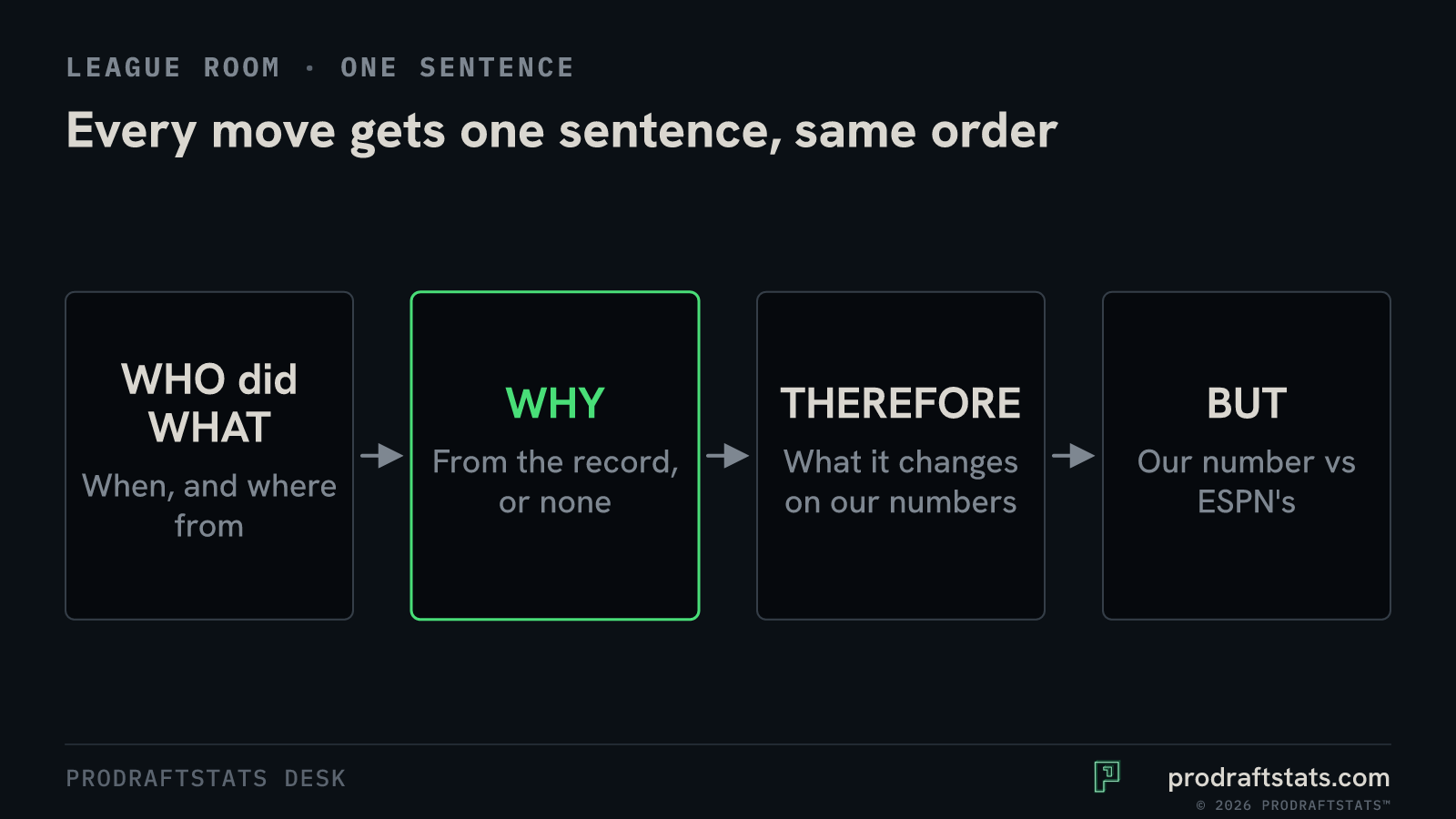
Because one sentence can’t cover a whole league room, the tape is designed with four views, each built for one question:
| View | What it answers |
|---|---|
| Tape | Who did what, when, and what it means. Days run across, one lane per seat. A filled dot is an add, a hollow dot a drop, a diamond across two lanes a trade. |
| Crowd | Where attention is going, and whether it lines up with our number. The top left is where our projection sits above ESPN’s while the crowd is moving the other way: the pickup nobody is looking at. It marks a disagreement between two numbers, not a verdict and not a reason to add. |
| Scarcity | What runs out at each position, and for which seats. The biggest drop between neighbours inside the starting ranks is marked as the cliff. |
| Horizon | Which weeks put several of your players on bye. A column where two or more of your players share a bye is a canyon. |
That’s why the sentence has a “why” slot that can be empty. When you watch a rival grab a receiver, the pull is to assume he knows something. Maybe he does. A click alone does not tell the tape why it happened, and the tape does not claim to know whether he knows something.
On a waiver wire, one manager’s click can look like a signal. But the click alone says nothing about motive. Which means the tape separates what happened from why it happened. When no reason is on the record, the sentence says so and shows where our number stands against ESPN’s. That is a comparison of two projections, not a reason to copy or fade the move.
The desk never invents a rival’s motive. A story with a guessed clause would be a column, and columns are not scored.
Send this to the leaguemate who sees a waiver pickup and assumes it’s a secret.
Source: ProDraftStats desk.
Only when a reason is on the record, such as news naming the player shortly before the move or a health tag on a dropped player. Otherwise it reads "no stated reason on the record."
No. A swap is either a trade or a drop and an add between two reads, and the tape cannot tell those two apart. It does not pretend to.
ProDraftStats launches in 2027. Join the free waitlist.