 PRODRAFTSTATS™PRODRAFTSTATS™
Rows 9 and 10 on your list can be four points apart. Here’s the picture that shows it.
A ranked draft list hides the distance between players. A value map shows it. It plots where your room takes a player against what our board says he's worth. It rings a gap only when the gap is bigger than the room's own noise. In our illustration, not a measured gap, rows 9 and 10 can sit four points apart.
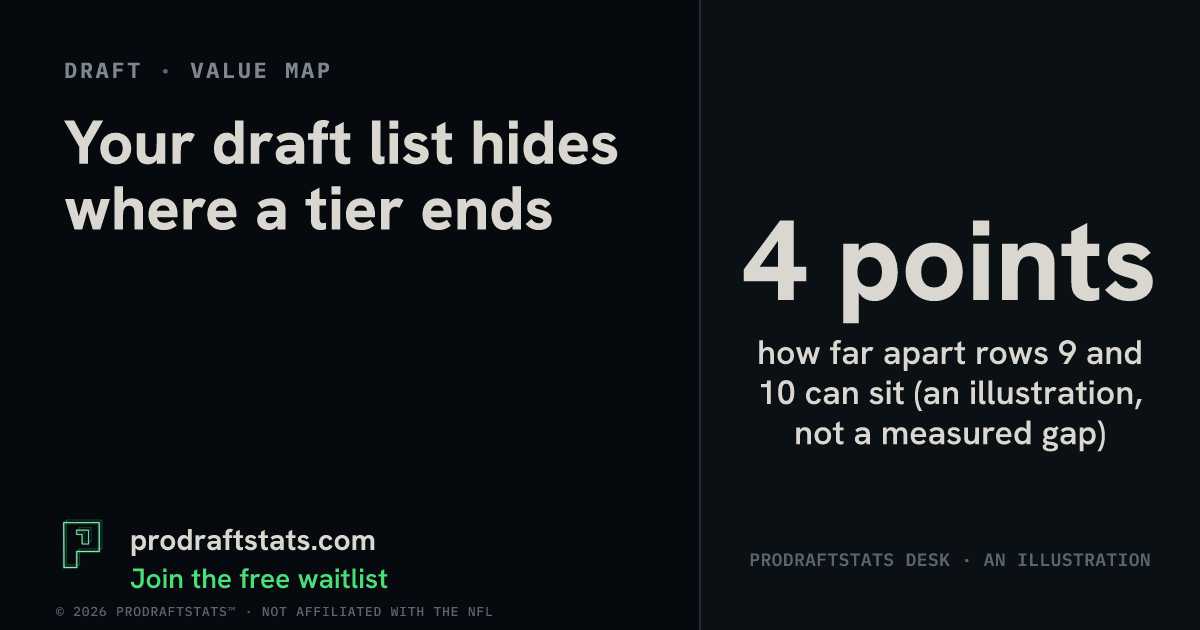
Send this to your league chat before the draft: the players in rows 9 and 10 might not be neighbours. In the example we mapped, they sit four points apart, and your list can’t show you that.
A list shows order only, so every step down looks the same size. We drew the distance: where your room takes a player, against what our board says he’s worth. One dot got a ring, and one plain sentence says why. We also turned down most of the other chart ideas, and wrote down each refusal. First, the ringed dot.
But a picture only earns its place on a draft clock if it shows something a sorted column can’t. The map shows three things, and each one is a decision you make in seconds:
Across the bottom is where the room takes a player, with 1 on the left. Up is points per game over a replacement starter.
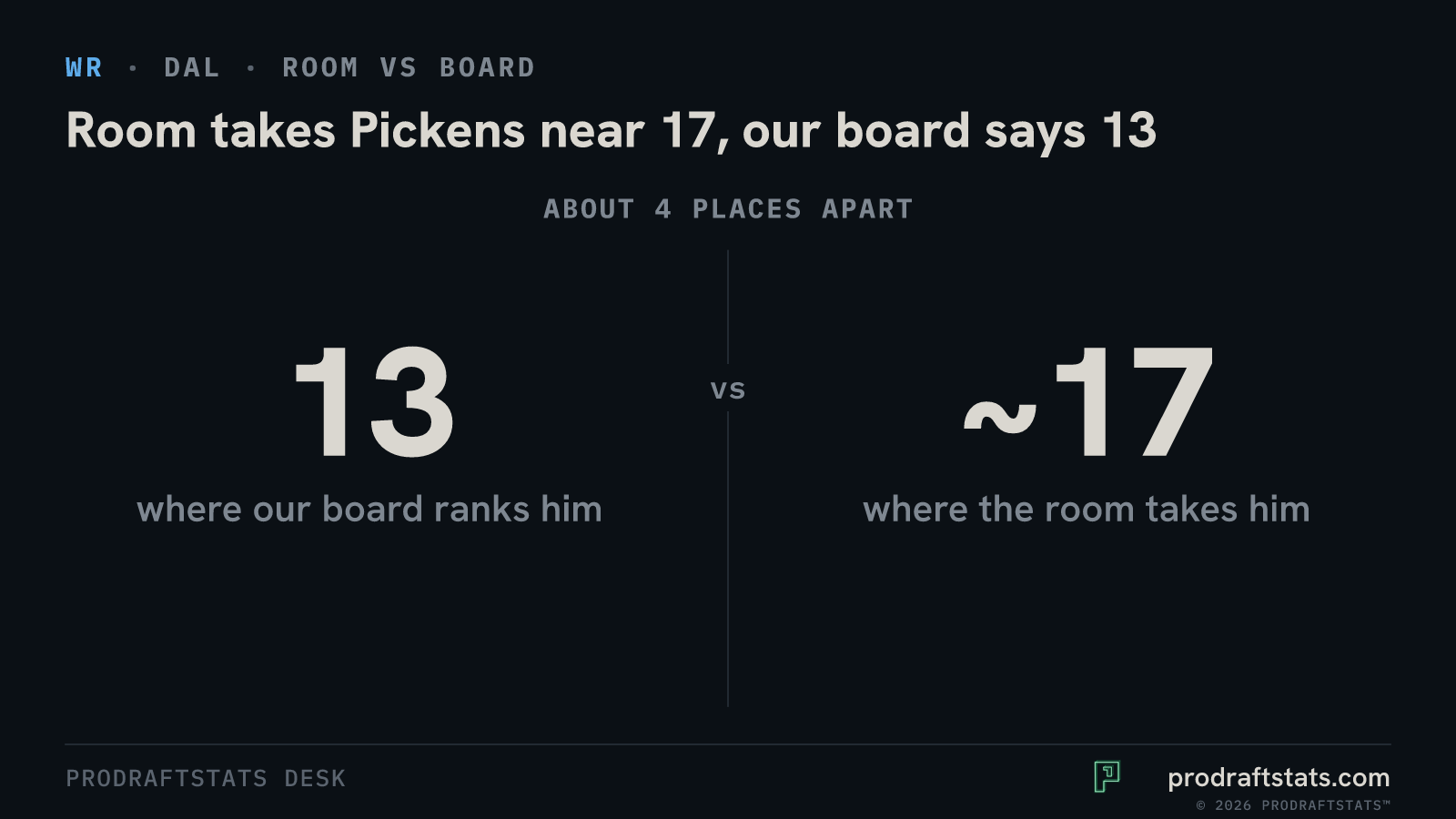
The desk’s own example is George Pickens (WR, DAL), and it is a different measure from the four-point illustration above: this one is in places, not points. The room takes him around 17. Our board ranks him 13. That puts him about 4 places later than he scores, at +5.7 points a game over a replacement starter.
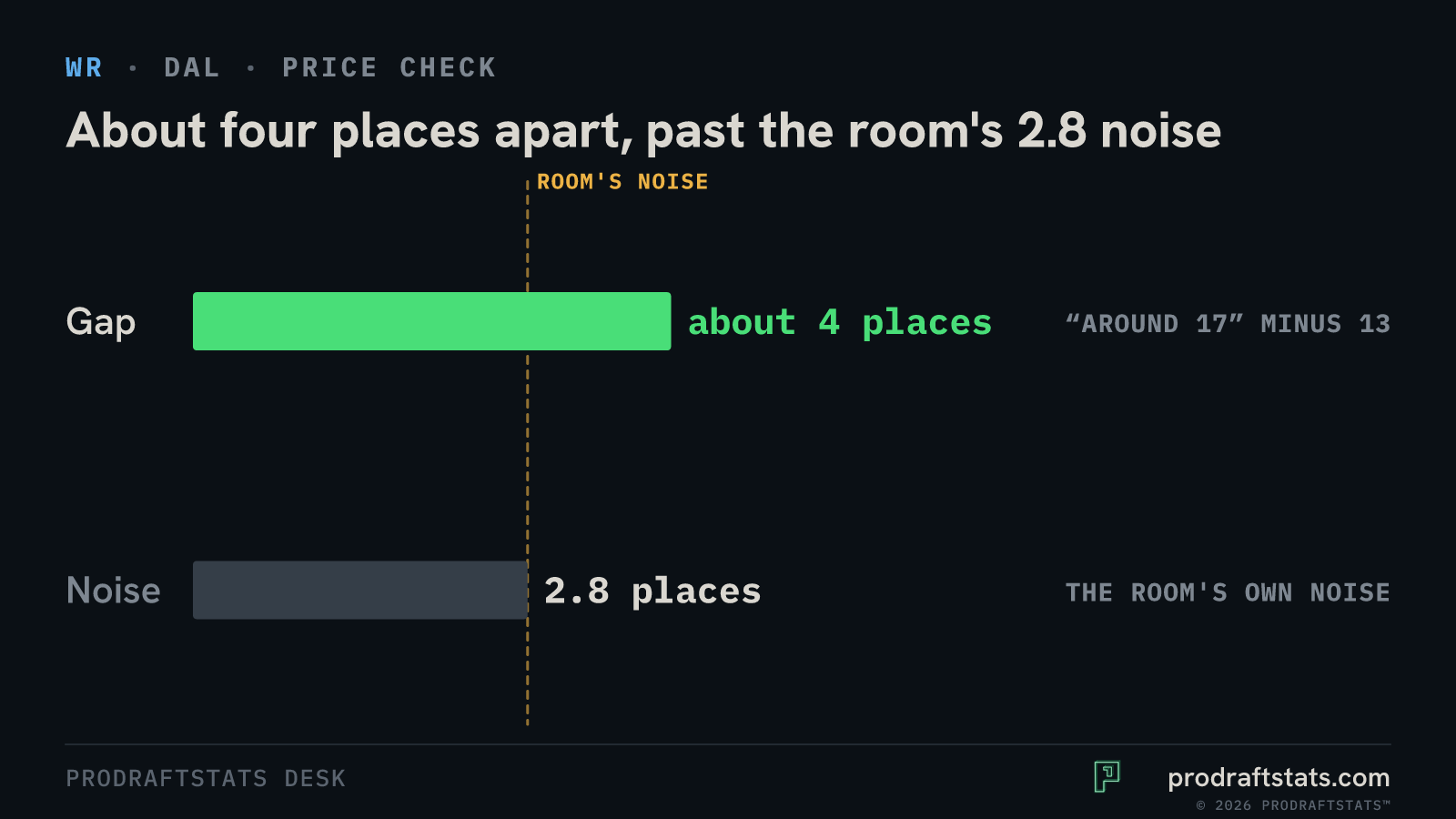
Four places on its own proves little, so a gap gets a ring only when it is bigger than the room’s own noise, about 2.8 places in this example. Pickens’ gap is about 4 places, since the room takes him “around 17”. Four is past 2.8, so the dot gets a ring and the label CHEAP.
Because that label can be misread, here is what it is. CHEAP names a rank disagreement between two lists. It is not a price and not an order, and a ring doesn’t mean the room is wrong. CHEAP is not a recommendation to draft him; it only says the room takes him later than our board ranks him, by more than the room’s own noise. It is one input to a draft decision, not an instruction, and what you do with it is your call.
But a ring alone says nothing. So every dot carries one plain sentence, written to three rules.
The verdict leads. The conclusion comes first, so even a clipped line still says which verdict it is.
Plain words, with the number it beat. The sentence says “a game”, “places” and “the room’s own noise”. It quotes both the disagreement and the bar it cleared, because a claim that quotes only its own size is just an assertion.
Precision that stays true. The quoted bar is written so it never reads as 3 > 3.
The ring’s explanation sits on the plot itself, beside the position colours, and gives the number: CHEAP · more than 2.8 places later than he scores. When there is no noise figure to compare against, the chart shows no key and no marks, and says so.
The last piece was a filter. Narrowing the map to one position already worked, but the control wasn’t on screen. Now it is, on the panel where “show me just the backs” pays best.
The map compares our board with the room, not with ESPN or with ownership, because neither is in the data. No 2026 results exist yet, so nothing here says a CHEAP read was right.
The four-point gap between rows 9 and 10 is an illustration of what can happen, not a measured typical gap. The 2.8-place noise is an example figure too. The +5.7 and the board’s rank of 13 are the desk’s own estimates; this post gives no measured accuracy for them. The cutoff is a hard line, so a gap just under 2.8 places and one just over it are not meaningfully different.
Send this to your league chat before the draft: rows 9 and 10 might not be neighbours.
Source: ProDraftStats desk.
CHEAP names a rank disagreement between two lists. It is not a price, an order or a recommendation to draft him. It means the room takes a player later than our board ranks him, by more than the room's own noise.
The room takes Pickens (WR, DAL) around 17 while our board ranks him 13, at +5.7 points a game over a replacement starter. His gap of about 4 places is bigger than the 2.8-place noise figure in the example, so he gets a ring. The rank of 13 and the +5.7 are the desk's own estimates.
No. It compares our board with the room. No 2026 results exist yet, so nothing in the post says a CHEAP read was right.
ProDraftStats launches in 2027. Join the free waitlist.