 PRODRAFTSTATS™PRODRAFTSTATS™
We counted every depth-chart climb in 30 days, and only a handful made the cut.
In a 30-day window of 2026 depth charts, 151 skill players changed rank and 14 climbed into the top two. A climb shows where a team placed a player, not what he will score. We count these moves but call none of them a breakout. Preseason promotions are untested as a predictor of production.
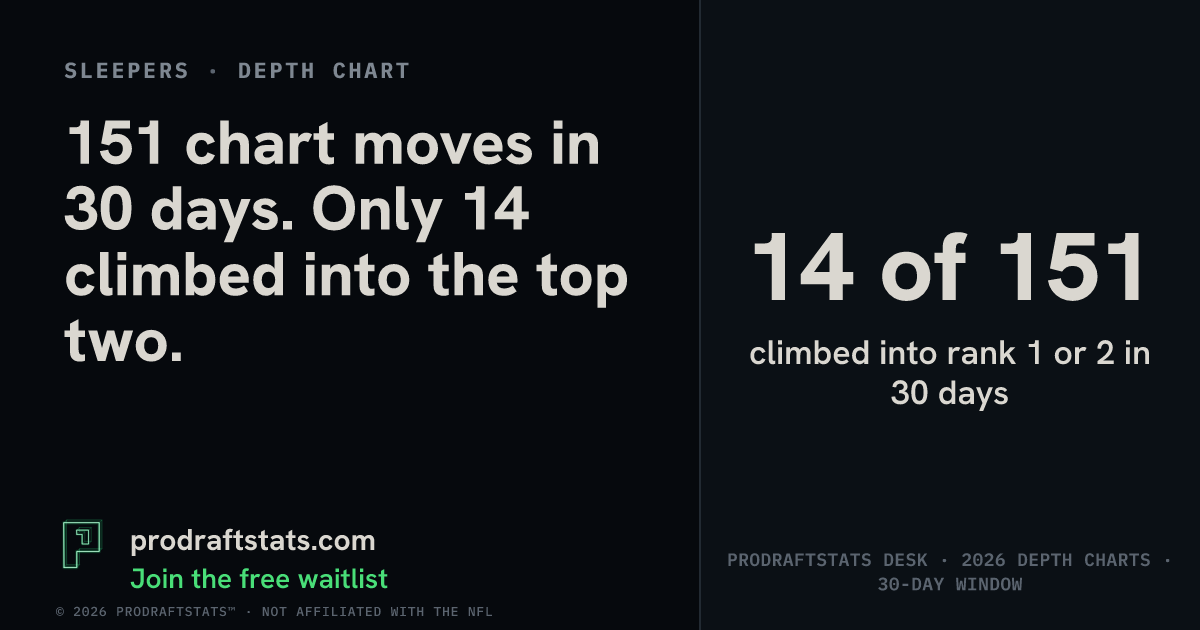
Somebody in your league chat has a backup who is “about to pop,” and the proof is always a depth chart. You’re supposed to nod and put in a waiver claim. Before you do, here is what the charts showed over thirty days: 151 skill players changed rank, and only 14 climbed into the top two on their team’s chart. Those 14 are the moves we count. We don’t call any of them a breakout, because a climb up a chart is a fact about where a team has placed a player, not a forecast of what he’ll score. So you get a short list instead of a rumor, and the one question that ends the argument in your chat: which depth chart said so, and when did it move? Below, the full count, what we print beside the rookies on it, and what we refuse to say.
Charts get published as a running record, not one current page. So when a player moves up, nobody is guessing from an injury report: the same man shows up ranked twice, at two timestamps. A chart is a club’s stated intention, and preseason charts are often vanilla.
But a record of every move is too much to read. In the thirty-day window, 151 skill players changed rank. Only 14 climbed and now sit at rank 1 or 2.
| Thirty-day window, 2026 charts | Players |
|---|---|
| Changed rank | 151 |
| Climbed and now rank 1 or 2 | 14 |
| Did not meet the cut (151 − 14) | 137 |
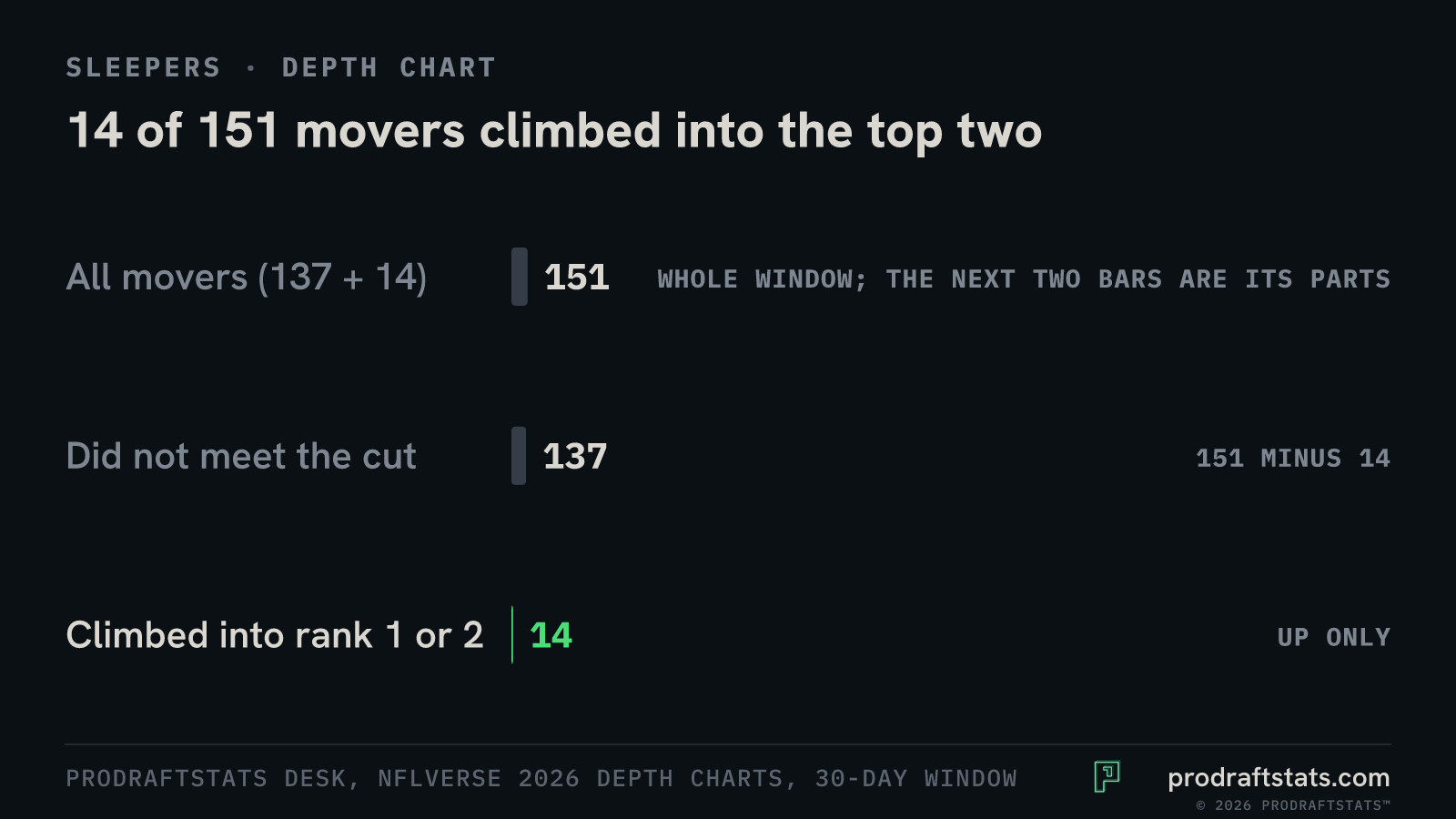
That’s why the cut matters. A list of 151 is a second board to read on a 45-second draft clock, which is the same as no help at all. Fourteen is a list a person can hold, and every row is a player whose chart rank rose into the top two. We chose that cut for readability. We have not shown it predicts anything, and we have not measured whether the other 137 moves, such as a receiver sliding from seventh to fifth, carry any signal. They simply fall outside it. This is one window in one preseason, so the count describes chart churn, not how many of these players will matter.
Moves go in both directions, because a demotion is news too. This list keeps up only, into the top two.
Fourteen names make a forecast tempting. But we have not tested whether a preseason promotion predicts fantasy production on past seasons. Because of that, the panel claims one thing: his rank moved up and he now sits near the top. You read it as an observation, and that refusal is printed on the panel itself, since a screen readers trust is where an unproven claim does the most damage.
Rookies get the same discipline. A player with no NFL history has no price on our board, and inventing one from a depth-chart rank would be fabrication. So the cell shows a dash. The dash means the board has no NFL record to price him from. It does not mean zero, and that gap is why a rookie is interesting.
Which means unpriced players don’t float to the top of the list either. “We can’t price him” describes our data. It is not evidence that he is good, and sorting on it would turn a missing number into a recommendation.
For players with little NFL record, the panel prints the round and overall pick exactly as recorded, as context. It is not a result and not a projection of the player.
Read the two columns together. A fourth-round pick whose chart rank just rose is a case where both facts, the pick and the move, can be read side by side. We make no claim about edge.
No results exist for any of these names, and we are not claiming any. Preseason promotions are untested as a predictor of production. A sleeper list is also a forecast that never gets marked. Suppose a list of nineteen names yielded one hit: memory tends to keep the one and drop the eighteen. That is a hypothetical, not this list. This list has 14 names and no results yet, so there is no hit rate to quote.
Send this to the person in your league chat who swears a backup is about to pop: ask which depth chart said so, and when it moved. That tells you what was observed, not what he will score.
Source: ProDraftStats desk; measured on the nflverse 2026 depth-chart time series over a thirty-day window.
In the thirty-day window of 2026 charts, 151 skill players changed rank and 14 climbed into rank 1 or 2. The other 137 fell outside the cut. The count describes chart churn, not how many will matter.
We haven't tested it. Preseason promotions are untested as a predictor of production on past seasons, so the panel only states that a player's rank moved up and now sits near the top. It is an observation, not a projection.
A player with no NFL history has no price on the board, and inventing one from a depth-chart rank would be fabrication. The dash means there's no NFL record to price him from. It does not mean zero.
ProDraftStats launches in 2027. Join the free waitlist.